The Ultrasound Memory Study is complete. Read about the results →
Lattice Rounds · a phone app from UltraDAO

Thirty seconds.
One number.
In real units.

Lattice Rounds is a set of short tests of perception and timing. A round takes about half a minute and gives you a number in milliseconds, items or percentage points, with the range it is likely to sit in. It is for people who are curious about how their own senses and attention behave. That is all it is.

ANDROID AND IPHONE · IN TESTING · RESEARCH MEASURES, NOT MEDICAL TESTS
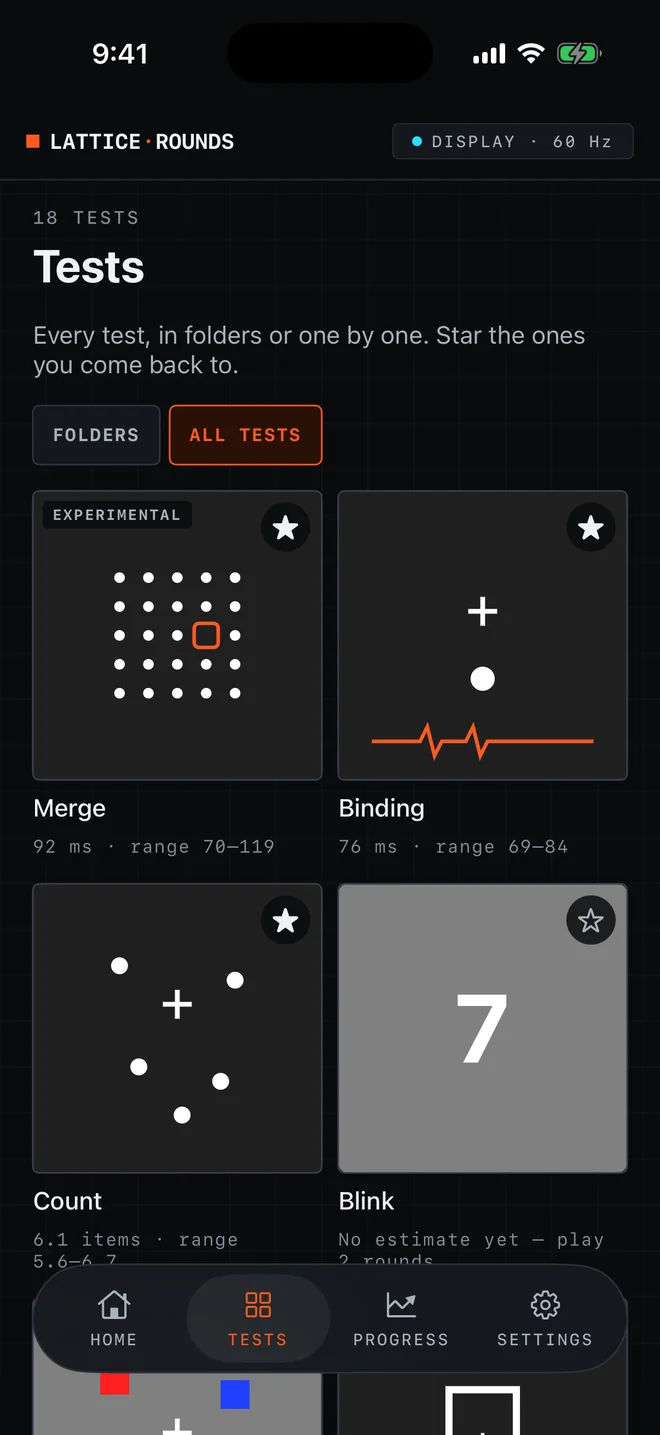
The Tests tab in Lattice Rounds: 18 tests shown as tiles, with Merge, Binding, Count and Blink at the top
The Tests tab · simulated data
01 · HOW IT WORKS

Play a round. Read a number. Come back.

01

Play a 30-second test.

Each test is one small task: count the dots, say which tone came first, tap how many flashes you saw. One screen explains it before you start, and the first round of any test is practice, with feedback, and is not counted.

02

Get your result in real units.

Milliseconds, items, percentage points. No points, no levels, no grade. A number is shown once two counted rounds are in, always with the range it is likely to sit in. One round alone is never presented as the answer, and two tests, Blink and Bind, hold their number back until about ten rounds.

03

Play again over days.

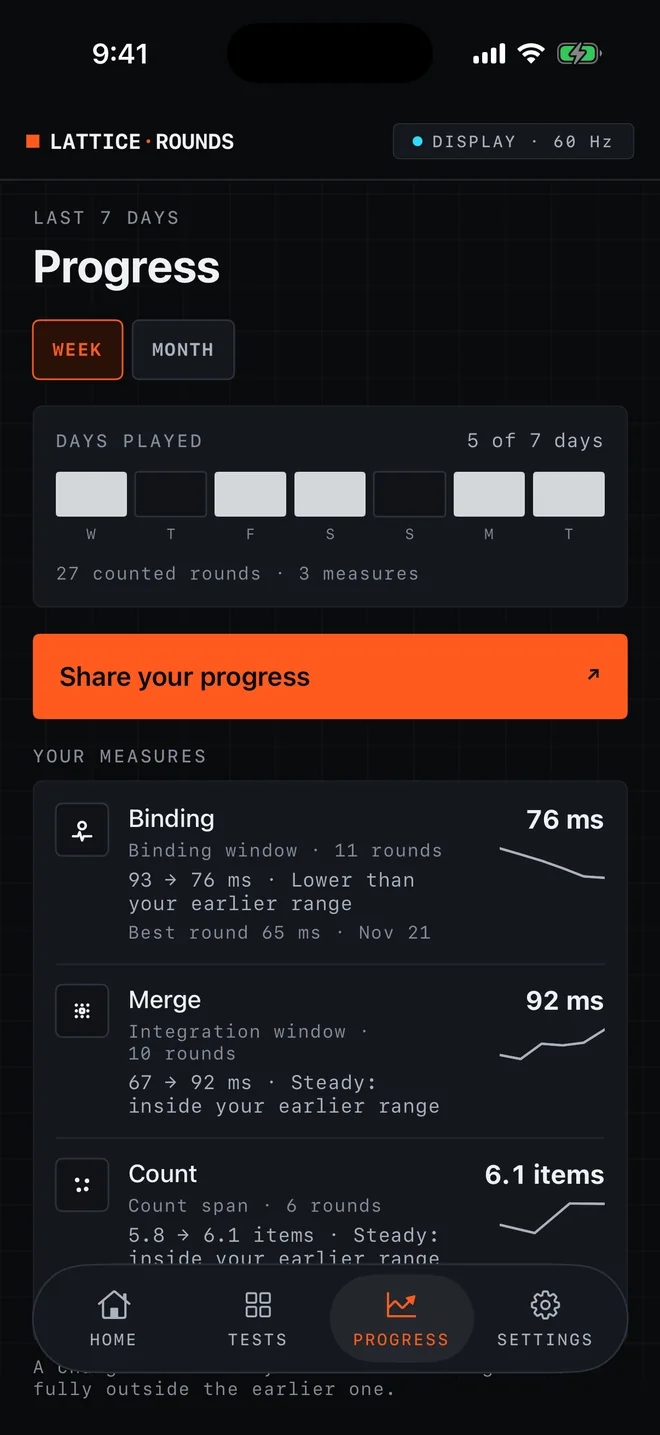
The range narrows as rounds add up, and most tests settle after roughly four to ten. After that you can see whether the number moves from one day to the next, and the Progress tab shows the days you played.

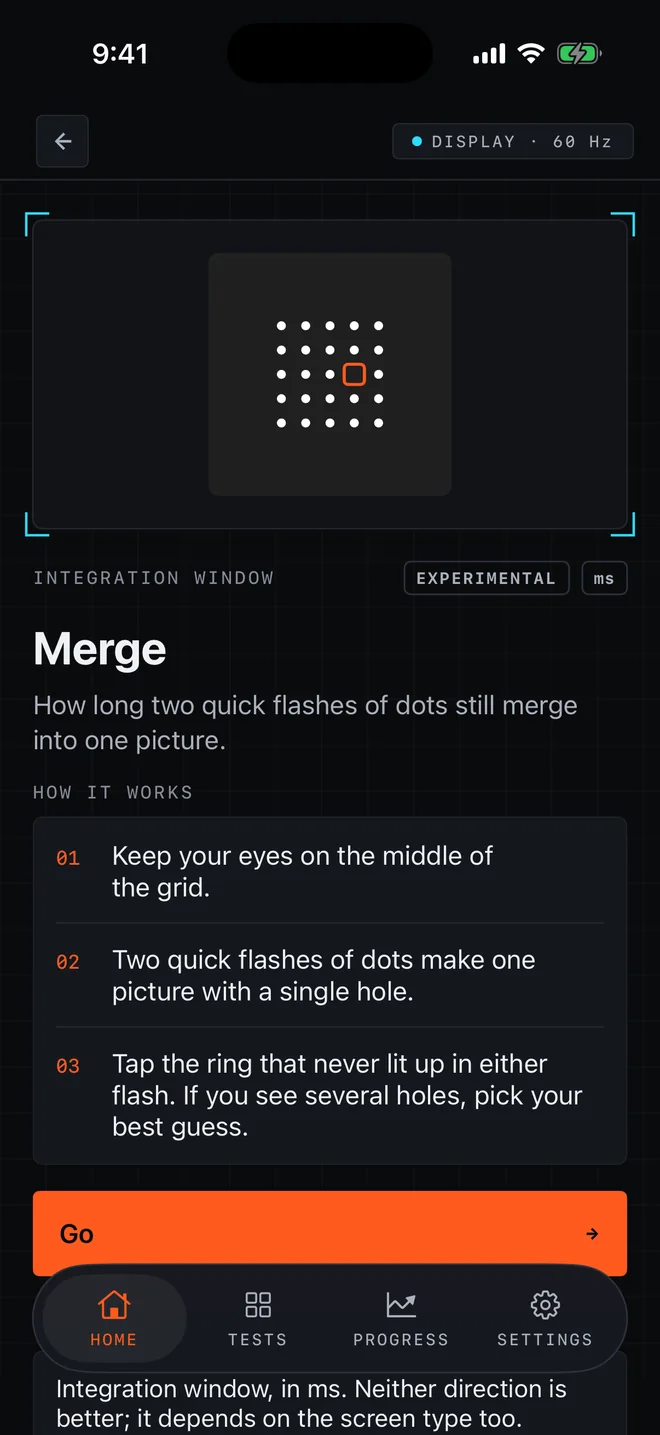
The Merge test’s explainer in Lattice Rounds: what it measures, three steps, and a Go button
One screen explains each test
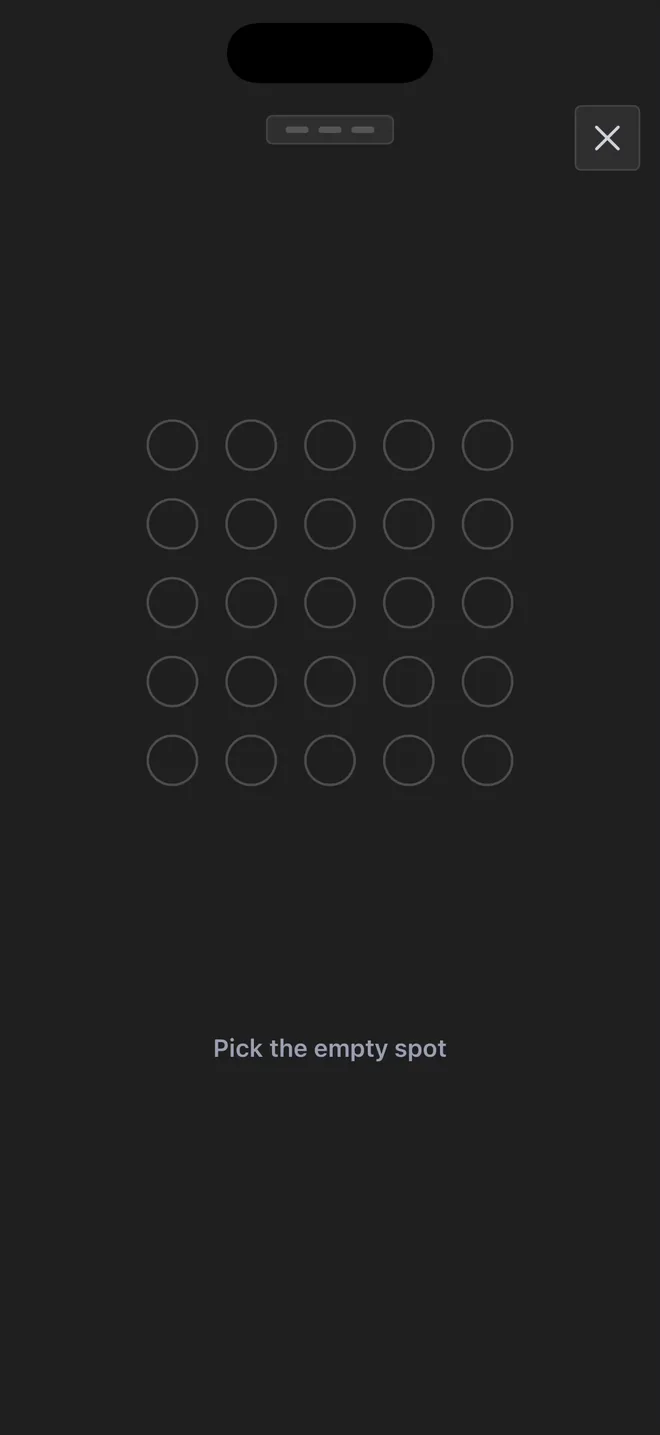
A Merge round in Lattice Rounds: a grid of rings with a cross in the middle and the prompt “Pick the empty spot”
A round of Merge
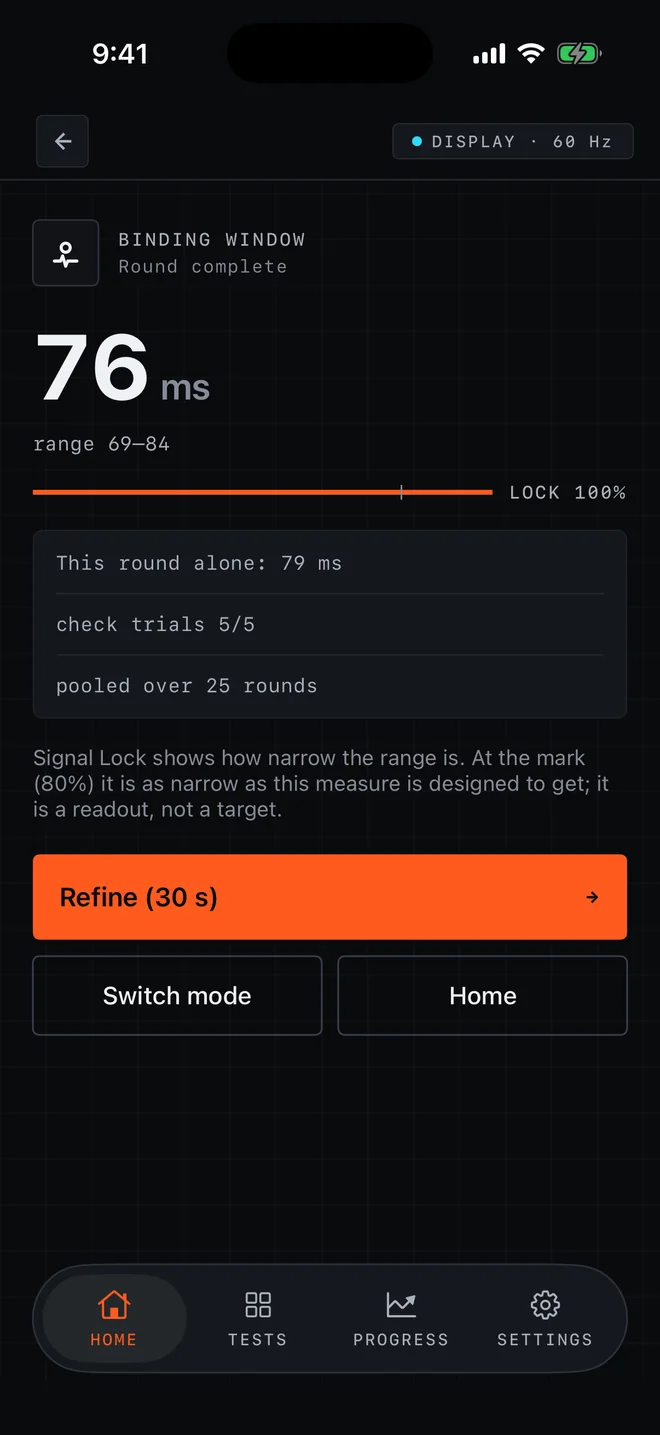
A result card in Lattice Rounds: binding window 76 ms, range 69 to 84, with the Signal Lock bar and the round’s check trials
A number and its range
The Progress tab in Lattice Rounds: days played this week and each measure with its latest number
Progress, one week

RESULTS SHOWN ARE SIMULATED DATA · NOT A PERSON'S

02 · THE TESTS

18 tests, one fixed format each.

Every test follows a task that perception and attention researchers already use. The descriptions below are the app's own. Where the research gives a typical range for adults, the app shows it; where it doesn't, the app says nothing.

The first three

The tests the app was built around. Each has a published range for untrained adults, which the app shows beside your own number.

Binding

BINDING WINDOW · MS

How close in time two clicks must be for your senses to tie them to a single flash.

Most untrained adults land around 60–120 ms; some are below 40 or above 150.

MODELLED ON · The sound-induced flash illusion

Count

COUNT SPAN · ITEMS

How many things you can count from a glance too short to look twice.

Most untrained adults land around 4–6 items.

MODELLED ON · Enumeration (subitizing) with a mask

Blink

BLINK DEPTH · PERCENTAGE POINTS

How often a second target slips past right after you’ve spotted a first one.

Most untrained adults land around 20–40 pp.

MODELLED ON · The attentional blink

New

Tagged New in the app until their own timing checks are finished.

Hold

NEW
ITEMS HELD · ITEMS

How many items you can keep in mind across a one-second pause.

Adults typically hold 3–4 items.

MODELLED ON · Change detection (visual working memory)

Inspect

NEW
INSPECTION TIME · MS

How briefly a simple shape must be shown for you to judge it.

Adults usually need about 40–100 ms.

MODELLED ON · Inspection time

Mask

NEW
MASKING TIME · MS

How long lingering dots around a briefly seen ring can be before its gap can’t be read.

MODELLED ON · Object-substitution (four-dot) masking

Experimental

Still being checked against published results. The app tells you to treat these numbers as provisional.

Merge

EXPERIMENTAL
INTEGRATION WINDOW · MS

How long two quick flashes of dots still merge into one picture.

Neither direction is better; it depends on the screen type too.

MODELLED ON · Temporal integration (the missing-dot task)

Order

EXPERIMENTAL
ORDER THRESHOLD · MS

How far apart a low and a high tone must start for you to tell which came first.

MODELLED ON · Auditory temporal order judgment

Pace

EXPERIMENTAL
PACE THRESHOLD · % OF A 300 MS INTERVAL

The smallest difference between two short intervals you can hear.

MODELLED ON · Interval discrimination

Beat

EXPERIMENTAL
BEAT THRESHOLD · % OF A 500 MS BEAT

How small a late click in a steady beat you can notice.

MODELLED ON · Detecting a late click in a steady sequence

Trace

EXPERIMENTAL
TRACE DELAY · MS

How long a brief glance stays readable after it’s gone.

Neither direction is better; it depends on the screen type too.

MODELLED ON · Partial report (iconic memory)

Bind

EXPERIMENTAL
BINDING COST · PERCENTAGE POINTS

How much harder it is to notice two colors swapping between shapes than a new color appearing.

Neither direction is better.

MODELLED ON · Feature binding in change detection

Sync

EXPERIMENTAL
STEADINESS · MS

How steadily you can tap along with a beat, and keep it when the clicks stop.

MODELLED ON · Synchronization and continuation tapping

Pulse · left hand and right hand

EXPERIMENTAL
PULSE WINDOW · MS

The shortest gap at which you feel two vibration pulses as two, for each hand.

Two tests, one per hand. Needs headphones. On iPhone only for now.

MODELLED ON · A tactile two-pulse gap
Controls

Never results. They are there to tell a change in the phone, your eyes, your ears or your alertness from a change anywhere else.

Tap check

CONTROL
REACTION TIME · MS

How quickly you tap when a circle appears. A control, not a score: it shows how alert you are today.

MODELLED ON · Simple reaction time

Gap

CONTROL
GAP THRESHOLD · MS

The shortest silence you can hear between two sounds. A hearing control, not a score.

MODELLED ON · Auditory gap detection

Flicker

CONTROL
FLICKER THRESHOLD · MS

The shortest dark gap you can see between two flashes. A visual control, not a score.

MODELLED ON · Two-flash visual resolution

A longer walk through each one is in The Tests in Lattice Rounds, in Plain Words.

03 · READING A NUMBER

A number, and how sure it is.

Every number comes with a range.

The range is where your number most likely sits, given the rounds played so far. A bar called Signal Lock shows how narrow it has become.

The first rounds are warm-up.

People get better at the task itself for a few rounds. The app treats those as warm-up so that learning the buttons is not mistaken for a change in you.

A change has to repeat.

A change means something only if it lands outside your earlier range and shows up again in another sitting. The app says “steady” when it does not.

Ordinary things move it.

Alertness, caffeine, sleep, lighting, the screen and practice all move these numbers. The tap check is there so a sleepy day can be told from anything else.

More in How to Read a Lattice Rounds Number.

04 · WHAT IT IS NOT

Not a medical test. Not a score.

  • It does not diagnose anything, and none of these tests is used here to assess any condition.
  • It does not measure intelligence, and it does not measure consciousness.
  • It does not rank you. There are no points, levels, streaks, percentiles or leaderboards, and nothing compares you with other people.
  • It is not training. Nothing in the app promises that a number will improve, or that playing changes anything outside the test.
  • We make no claims about what your numbers mean for your life. They are your own measurements, for your own curiosity.

These are research measures of perception and attention. They are not medical tests and do not assess your health, intelligence or any condition.

Some tests flash letters, rings and noise patterns rapidly. If you are sensitive to flashing images, do not use this app.

05 · YOUR RESULTS

Kept on your phone unless you choose otherwise.

Nothing is sent anywhere by default.

Results stay on the phone. They are not used for advertising, analytics or tracking, and nobody reads them.

An UltraDAO.to account is optional.

You can link one in Settings. Accounts are made on this website, not in the app. Results go to your account only if you turn on “Keep a copy on my account”, and you can remove that copy at any time.

Sharing is yours to start.

The app can make a picture or a short video of a week or a month of your own rounds, on the phone, for you to send wherever you like. “Share a link” puts that one card at an address anyone with the link can open, and you can take it down.

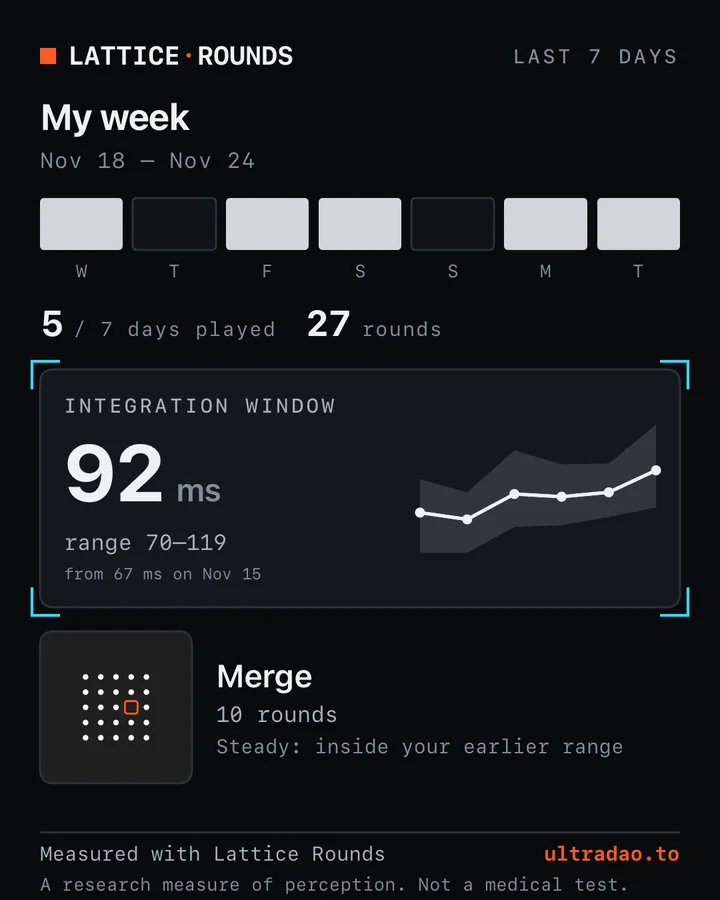
A Lattice Rounds share card titled “My week”: 5 of 7 days played, 27 rounds, and Merge with an integration window of 92 ms, range 70 to 119
The share card · simulated data
Phone only

On Android today. iPhone in testing.

Lattice Rounds runs on a phone and nowhere else; there is no version for a computer. Android has a direct download, with 16 of the 18 tests. The iPhone version comes through TestFlight, and that link is not open yet.