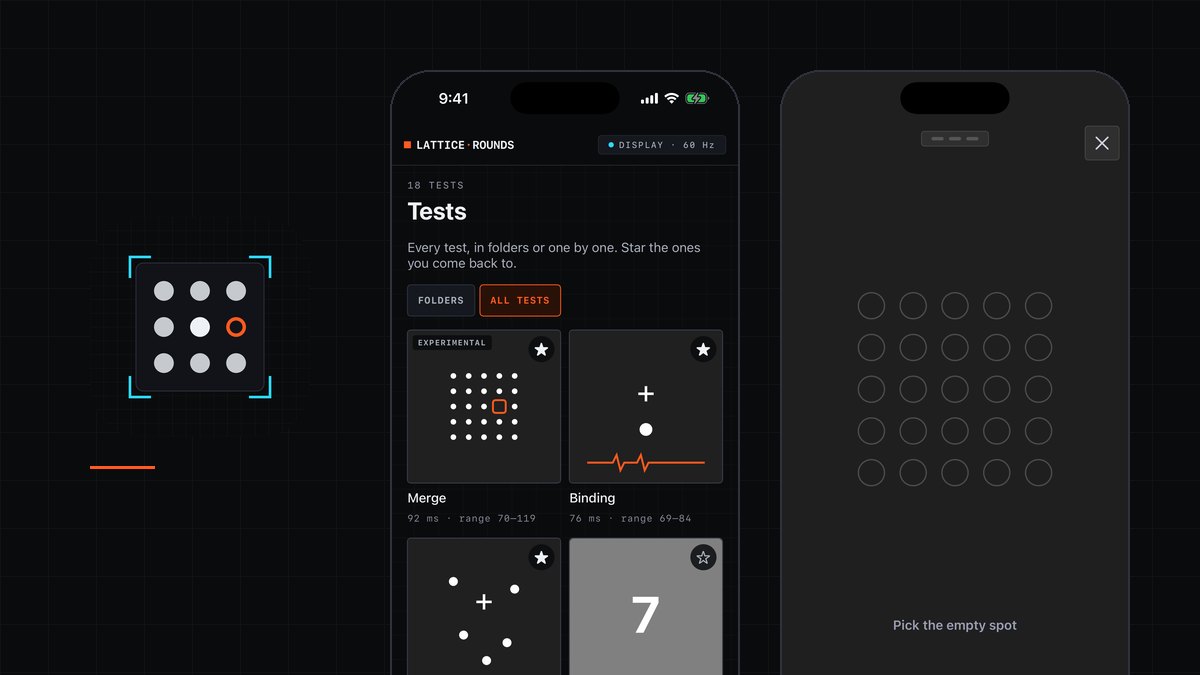
Lattice Rounds is a phone app from UltraDAO. It runs short tests of perception and timing, about thirty seconds each, and gives you a number in real units with the range it is likely to sit in. This post is about where it came from, because the question it started with was much bigger than what the app does, and we would rather say that plainly.
The question it started with
Sterling Cooley, who started UltraDAO, wanted to know whether there was any way to test consciousness. It is the kind of question his work has circled for a long time: as The UltraDAO Story tells it, he began ultrasound research in 2013, and by 2014 he was building ultrasound hardware for research into neural and consciousness stimulation.
A phone app cannot answer that question, and Lattice Rounds does not try to. It does not measure consciousness, and nothing in the app says it does.
What the question did was lead somewhere useful: to the tasks that people who study perception and attention already use. None of them reaches for anything as large as consciousness. Each one measures a single, small, well-defined thing. How close in time can two clicks be before your senses tie them to one flash? How many dots can you count from a glance too short to look twice? How often does a second target slip past right after you have spotted a first? Those three are tests in the app today.
They are research tasks. In Lattice Rounds none of them is used to diagnose anything, and we make no claim about what a result says about a person.
The n-back, in 2013
There is an older thread too. In 2013 and 2014, when he was starting out in ultrasound, Sterling was introduced to the n-back task. The task goes back to Wayne Kirchner in 1958. You are shown a sequence of things, one after another, and you signal whenever the current one matches the one from n steps earlier. The dual n-back, proposed by Susanne Jaeggi and colleagues in 2003, runs two sequences at once, typically one you see and one you hear. In the version he used, a square lit up somewhere on a grid of nine while a voice read out letters, and you had to keep track of both.
He thought it was a great test. He kept taking it, and he got good at it.
Two things stayed with him.
- It is striking to get a plain measurement of something your own mind does. Not an opinion about yourself. A number.
- The n-back is hard to start. The rules take a while to sink in, the first sessions are discouraging, and it is not easy to pick up unless someone is sitting beside you explaining it.
One note on the n-back's reputation, since it tends to come up. A 2008 paper claimed that practising the dual n-back raises scores on tests of fluid intelligence. Later studies failed to reproduce that, and whether such training carries over to anything else is, in the words of the article that summarizes the research, still controversial. We take no side. Lattice Rounds is not training, and it does not promise that any number will improve.
What we built instead
Lattice Rounds has no n-back, and nothing like it. It is our answer to the same curiosity, with a much lower cost of getting started:
- Each test has one fixed format, explained on a single screen before you play.
- A round takes about thirty seconds.
- The first round of any test is practice, with feedback, and is not counted.
- There is no ladder of levels to climb.
- Your result comes in real units: milliseconds, items or percentage points, always with a range.
There are eighteen tests today. Three are the ones the app was built around, three are tagged New, nine are tagged Experimental and three are controls that are never results. The Tests in Lattice Rounds, in Plain Words goes through each one.
What it is for
It is for people who are exploring this kind of thing, or who are simply curious: what are my response times and thresholds on different kinds of tests, and do they move from day to day? That is all it is.
So the app has no scores, no ranks, no streaks and no comparisons with other people. Results stay on your phone unless you choose to keep a copy on your UltraDAO.to account or to share a card. How to Read a Lattice Rounds Number covers what a result does and does not tell you.
Where it stands
Lattice Rounds is in testing, and it runs on phones only; there is no version for a computer. On Android there is a direct download today, with sixteen of the eighteen tests. The iPhone version comes through TestFlight, and that link is not open yet. Get Lattice Rounds has the steps for both.
The tests in Lattice Rounds are research measures of perception and attention. They are not medical tests and do not assess your health, intelligence or any condition. Nothing here is medical advice, and no claim is made about what any result means for a person.