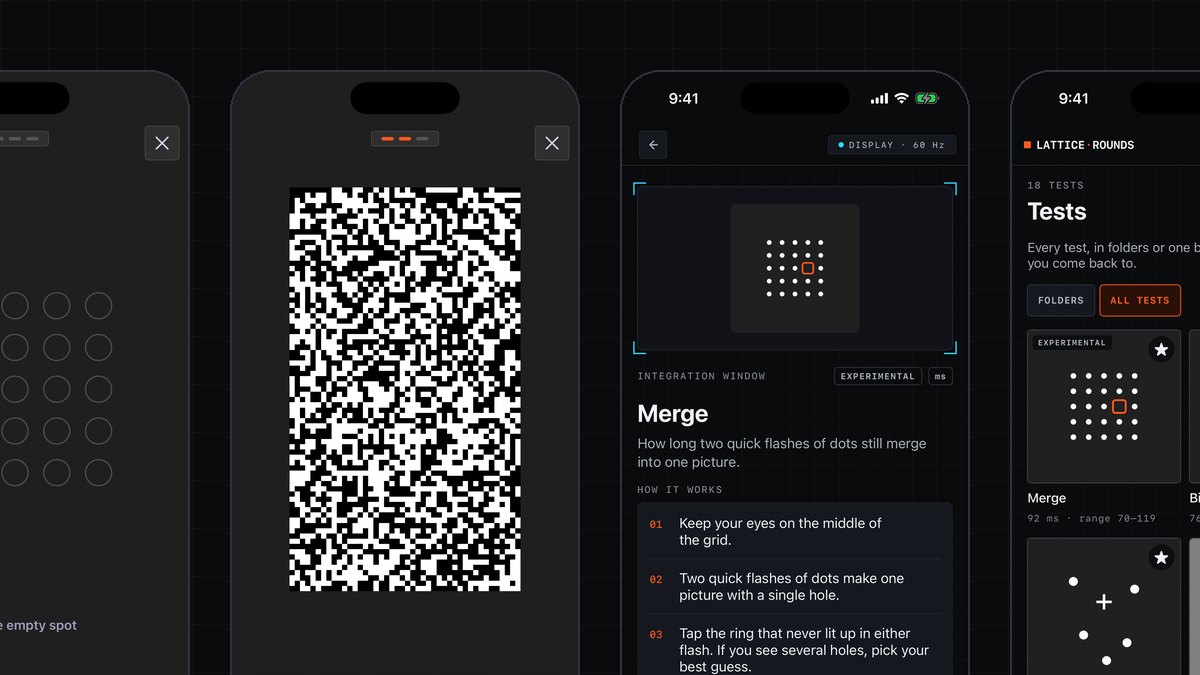
Lattice Rounds has eighteen tests. Each is a short task that perception and attention researchers already use, cut down to a round of about thirty seconds on a phone. This is the list, in the app's own groups, with what you do and what the number means.
Two things hold for all of them. The result is in real units, with a range. And none of them is a medical test: they measure a threshold or a span on the day you played, nothing more.
The first three
These are the tests the app was built around.
Binding
A quick flash appears with one or two clicks, and you tap how many flashes you saw. When two clicks come close enough together, one flash can look like two. Researchers call this the sound-induced flash illusion. Your number is the binding window, in milliseconds: the click gap at which one flash looks like two half the time. The app's note on it: most untrained adults land around 60–120 ms; some are below 40 or above 150. About one person in five barely gets the illusion at all, and the app says so when that is you.
Count
Dots flash for a twentieth of a second, then noise covers them, and you tap how many there were. This is enumeration, sometimes called subitizing for the small numbers you take in at once. Your number is the count span, in items: how many dots you count exactly right 70% of the time. Most untrained adults land around 4–6 items, and it rises over the first rounds as you learn the task.
Blink
Letters flash by, one every tenth of a second, and two of them are numbers. You report both. People often miss the second when it follows the first closely, an effect known as the attentional blink. Your number is the blink depth, in percentage points: how much less often you catch the second number at a short gap than at a long one. Most untrained adults land around 20–40 pp. It is the slowest test to settle, at about ten rounds, and the app holds the number back until then.
New
Tagged New in the app until their own timing checks are finished.
- Hold. Colored squares appear, vanish for a second, and return; you say whether one changed color. It follows change detection, a standard way to estimate visual working memory. The number is items held. Adults typically hold 3–4.
- Inspect. Two joined lines flash before noise covers them, and you tap the side that was longer. How fast you tap doesn't count. The number is your inspection time, in milliseconds: how briefly the lines can be shown for you to get it right 80% of the time. Adults usually need about 40–100 ms.
- Mask. Eight rings flash, four dots mark one of them and may linger after the rings vanish, and you tap the direction of that ring's gap. This is object-substitution masking. The number is the masking time, in milliseconds. The app gives no typical range for it.
Experimental
These are still being checked against published results. The app tells you to treat every number here as provisional, and it gives no typical ranges for them.
- Merge. Two quick flashes of dots make one picture with a single hole, and you tap the ring that never lit up. It measures how long two flashes still merge into one picture: the integration window, in milliseconds. Neither direction is better. It is the one Sterling, who started UltraDAO, likes most.
- Order. A low tone and a high tone, one starting a moment before the other; which came first? The order threshold, in milliseconds.
- Pace. Two short intervals, each marked by two clicks; which was longer? The pace threshold, as a percentage of a 300 ms interval.
- Beat. Five clicks in a steady beat with one gap a little late; which gap was off? The beat threshold, as a percentage of a 500 ms beat.
- Trace. Eight digits flash, then a bar marks where one of them was; which digit was there? It measures how long a brief glance stays readable: the trace delay, in milliseconds. Neither direction is better.
- Bind. Four colored shapes vanish and return; did anything change? It compares noticing two colors swapping places with noticing a new color: the binding cost, in percentage points. Neither direction is better.
- Sync. Tap along with a beat, then keep it going when the clicks stop. Steadiness is the spread of your taps, in milliseconds.
- Pulse, left hand and right hand. The phone buzzes once or twice in one hand and you tap how many pulses you felt with the other. Two tests, one per hand, each with its own pulse window in milliseconds. You wear headphones playing soft noise so you can't hear the buzz.
Merge and Trace also depend on the kind of screen your phone has, so their numbers are only comparable on the same phone.
Controls
Three tests are never results. They exist so that a change in your phone, your eyes, your ears or your alertness can be told apart from a change anywhere else.
- Tap check. A circle appears after a random wait and you tap as fast as you can. It shows how alert you are today. Touch screens add some delay of their own, so compare it only on the same phone.
- Gap. One short burst of sound, or two with a tiny silence between; a hearing control. Use the same headphones each time.
- Flicker. One flash, or two with a tiny dark gap between; a visual control, accurate to within one frame of your screen.
What none of them is
None of these is an n-back, an IQ test or a diagnostic test, and the app has no overall score that adds them up. Each number stands on its own. How to Read a Lattice Rounds Number covers ranges, warm-up rounds and what moves a result, and Where Lattice Rounds Came From tells the story behind the app.
Some tests flash letters, rings and noise patterns rapidly. If you are sensitive to flashing images, do not use the app.
The tests in Lattice Rounds are research measures of perception and attention. They are not medical tests and do not assess your health, intelligence or any condition. Nothing here is medical advice, and no claim is made about what any result means for a person.