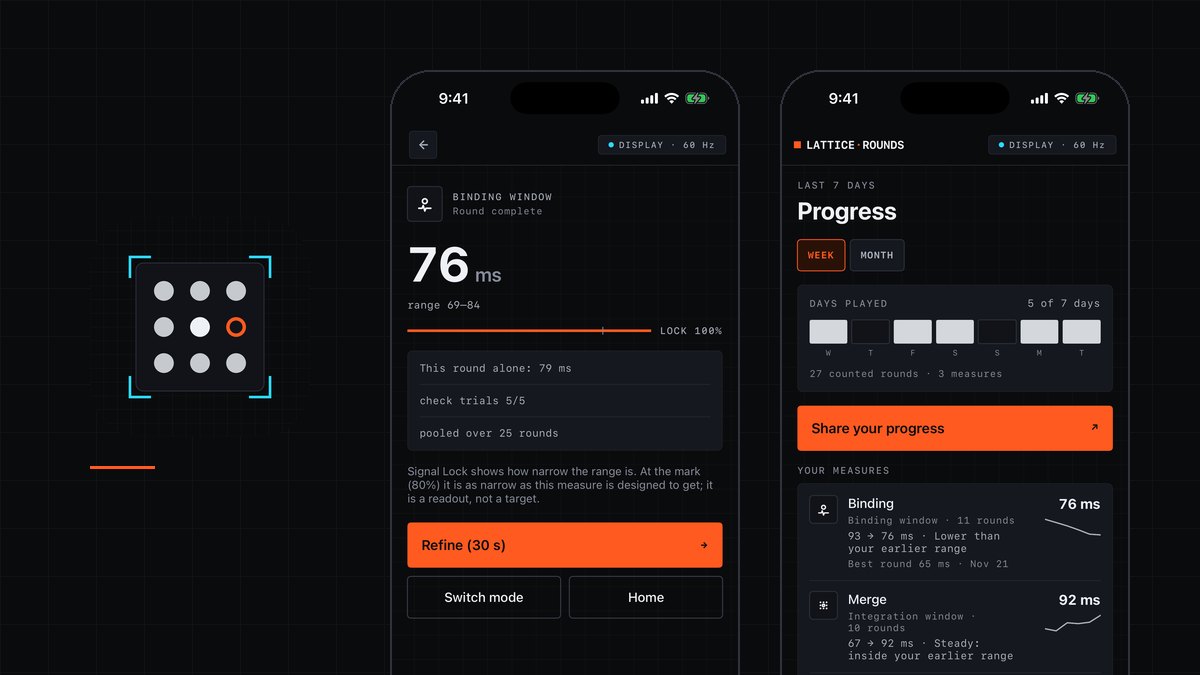
Every test in Lattice Rounds ends the same way: a number in real units and a range beside it. This post is about how to read that pair without reading too much into it.
A number and a range
The number is the app's best estimate of your threshold or span on that test: milliseconds, items or percentage points. The range next to it is where the true value most likely sits, given the rounds you have played. It is an 80% range, so it is wide when there is little to go on and narrows as rounds add up.
A bar called Signal Lock shows how narrow the range has become. When it reaches its mark, the range is about as narrow as that test is designed to get.
One round alone is never shown as your result. A number appears once two counted rounds are in, and it is pooled over your rounds, with recent ones counting more.
The first rounds don't count the way later ones do
- The first round of any test is practice. It gives you feedback and is not counted.
- The next few are warm-up. People get better at the task itself for a while: where to look, which button is which. The app treats those rounds as warm-up so that learning the buttons is not mistaken for a change in you.
- Each test says how long it takes to settle. Most need roughly four to ten rounds. Blink and Bind hold their number back until about ten.
Is a typical range a target?
No. For five tests the research gives a range that most adults fall in, and the app shows it beside your number so you have something to hold it against. For example, most untrained adults land around 4–6 items on Count and 60–120 ms on Binding. Plenty of people sit outside those ranges, and nothing follows from that.
For the experimental tests the app gives no typical range at all, because there is not one it can stand behind. And for three of them, Merge, Trace and Bind, neither direction is better: a higher number is not a win and a lower one is not a loss.
When has a number really moved?
Numbers wobble. The app only says a measure has moved when your new range sits fully outside your earlier one. Otherwise the Progress tab says it is steady, inside your earlier range. Even then, a change is worth believing only if it shows up again in another sitting.
The wording is deliberately flat: lower or higher, never better or worse.
What moves a result
Ordinary things, mostly:
- how alert you are, and how you slept
- caffeine
- the lighting in the room and the brightness of the screen
- how far you hold the phone
- speaker, wired headphones or Bluetooth, for the tests with sound
- a different phone
- practice
That is what the three controls are for. The tap check shows how alert you are today; Gap and Flicker check your hearing and your eyes at the simplest level. If a result moved and the controls moved with it, the likeliest explanation is the day you are having. Keeping the phone, the headphones and the distance the same from one sitting to the next makes your numbers easier to compare.
What a number cannot tell you
A Lattice Rounds number is a measurement of one small thing on one day. It is not a score, it does not rank you against anyone, and the app never adds the tests up into a total. It does not measure intelligence or consciousness, and it cannot tell you anything about your health. If you have a concern about your health, a phone app is the wrong tool; talk to a clinician.
What it can do is the thing it was built for: show you, in plain units, what your own thresholds and response times look like, and whether they move.
Where your numbers live
On your phone. Nothing is sent anywhere unless you choose it. You can link an UltraDAO.to account and turn on “Keep a copy on my account”, which copies each round's result and each sitting's estimate there; you can remove that copy whenever you like. You can also share a picture or a short video of a week or a month, made on the phone, or a link to that one card.
For the full list of tests, see The Tests in Lattice Rounds, in Plain Words. To install the app, see Get Lattice Rounds.
The tests in Lattice Rounds are research measures of perception and attention. They are not medical tests and do not assess your health, intelligence or any condition. Nothing here is medical advice, and no claim is made about what any result means for a person.