
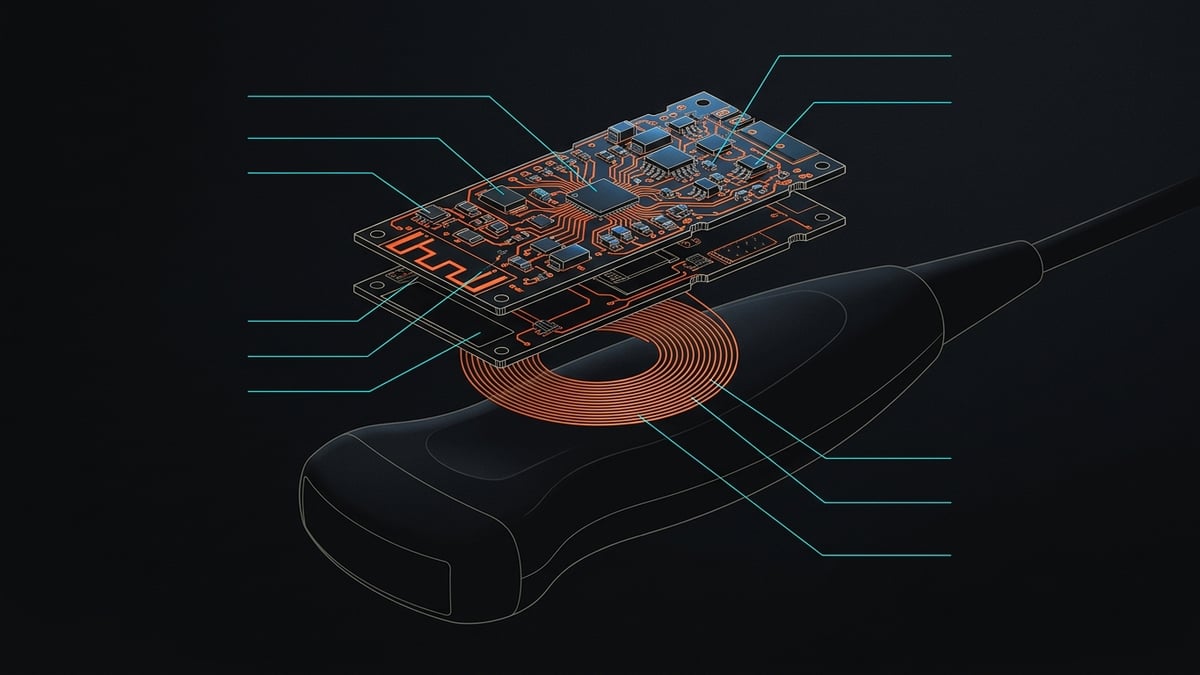
The US PRO 2000 is a handheld ultrasound — a sturdy, ordinary instrument that, on its own, plays only what it shipped with. PULSE is the module we build to change that. Installed inside the ultrasound, it makes the instrument programmable: any frequency program in the UltraDAO library can be loaded onto it from your phone with one NFC tap, and swapped just as easily.
This post is a tour of that hardware for the curious non-engineer. What is actually on the board, why each part earns its place, how a frequency travels from your library into the instrument, and what the whole assembly weighs, costs, and — just as important — what it is not.
The framing matters, so we will state it up front. PULSE is an instrument for wellness and research use. It is not a medical device and it is not FDA cleared. We build it so people can run frequency programs on real hardware and study what they are doing carefully. That is the entire job description.
What PULSE is
PULSE is a small circuit board — hardware revision REV.A1, our first — that installs into the US PRO 2000. The ultrasound provides the transducer, the power, and the housing; PULSE provides the intelligence. Once installed, the instrument carries one frequency program at a time and plays exactly that program until you flash another.
The library it reads is the point. The plain-frequency set spans 20 to 1500 Hz, each program carrying a one-word codename — Velvet at 20 Hz, Balance at 100 Hz, Crystal at 1000 Hz — and each has been measured on real hardware within 0.11 percent of its nominal frequency. Beyond the plain set there are nested programs, where one wave shapes another: one flagship runs a 39 Hz envelope over a 1755 Hz carrier, held in a 45-to-1 phase lock. These programs are signed for this board, and no third-party hardware decodes them.
The tap, from the inside
From the outside the flow is short. Open the UltraNFC app on your phone, pick a frequency from your library, and hold the phone to the device's NFC zone. The transfer itself is small — a frequency engine is a compact signed firmware image, on the order of six kilobytes — so the tap is over quickly.
What happens inside is more careful. First the board CRC-checks the transfer, confirming that every byte arrived intact and nothing was corrupted in the air. Then it verifies the payload's signature against keys provisioned by UltraDAO.
A good signature stays. A bad signature never lands.
That second check is the one worth pausing on: the device will not run an unsigned or tampered program, no matter how it arrives. Flashing is also deliberately stateless. Any program written over any other lands byte-identical, and only the engine region is touched — the factory firmware and the device's own calibration are never disturbed.
What's on the board
Four parts do most of the work, and each one is there for a reason.
- RP2040, dual-core, at 133 MHz. The board's brain — a small microcontroller with two processor cores. It handles the NFC conversation, runs the verification, and flashes the verified wave into the instrument. It is a widely used, well-documented part, which matters when the goal is hardware people can reason about.
- 16 MB of QSPI flash. Non-volatile storage — memory that keeps its contents with the power off. The signed program is written here and checked before anything else happens. Sixteen megabytes is enormous next to a six-kilobyte engine; storage is deliberately not the constraint.
- PN7150 NFC controller. A dedicated chip that manages the radio conversation with your phone, speaking ISO/IEC 14443 types A and B — the same short-range standard family behind contactless cards. It is why the tap feels like tapping a transit card: at the radio level, that is essentially what it is.
- A 27.12 MHz crystal. The clock. NFC radios operate at 13.56 MHz, and 27.12 MHz is exactly twice that — a stable reference the radio divides down to keep its timing precise. Unglamorous, and everything else depends on it.
The honest physicality
The whole assembly — board, NFC antenna, and mounting harness — measures 82 by 38 millimeters and weighs 10.7 grams. There is no battery, and that is not an omission: PULSE draws its power from the ultrasound it lives inside, so there is nothing to charge and no cell to age.
The parts that touch the world belong to the US PRO 2000 itself: a 24 mm piezo transducer driving a 1 MHz carrier, output up to 1.6 watts per square centimeter, and an effective depth of about 40 mm in soft tissue. PULSE decides what wave the instrument plays; the ultrasound does the playing.
Getting one
There are two ways to buy. The PULSE Module on its own is $99, for people who already have a US PRO 2000 and want to install the board themselves. The US PRO 2000 with PULSE already installed is $299, assembled and ready. Both are built in Washington state and ship within the United States only.
Every device ships with the 100 Hz program — codename Balance — already flashed, and Balance is free with every account, so the instrument does real work out of the box with nothing else to buy. Additional frequencies are sold individually on the website at $10 each through ordinary card checkout; some are gifted, and some are granted through taking part in research. The UltraNFC app on your phone is where your library lives and flashes from — purchases happen on the website.
That is the tour: one modest board that turns a fixed-function ultrasound into an instrument that plays a whole library, checks its own inputs, and refuses what it cannot verify. The full spec sheet, ordering, and FAQ live on the device page. For the wider context — what the frequency programs are and how the research around them is organized — the research page and the DAO page describe it plainly.
UltraDAO devices and frequency programs are wellness and research instruments. The PULSE system is not a medical device, is not FDA cleared, and nothing in this post is medical advice — no therapeutic claims are made. Ultrasound neuromodulation is an active area of research; consult a qualified clinician for health decisions.