
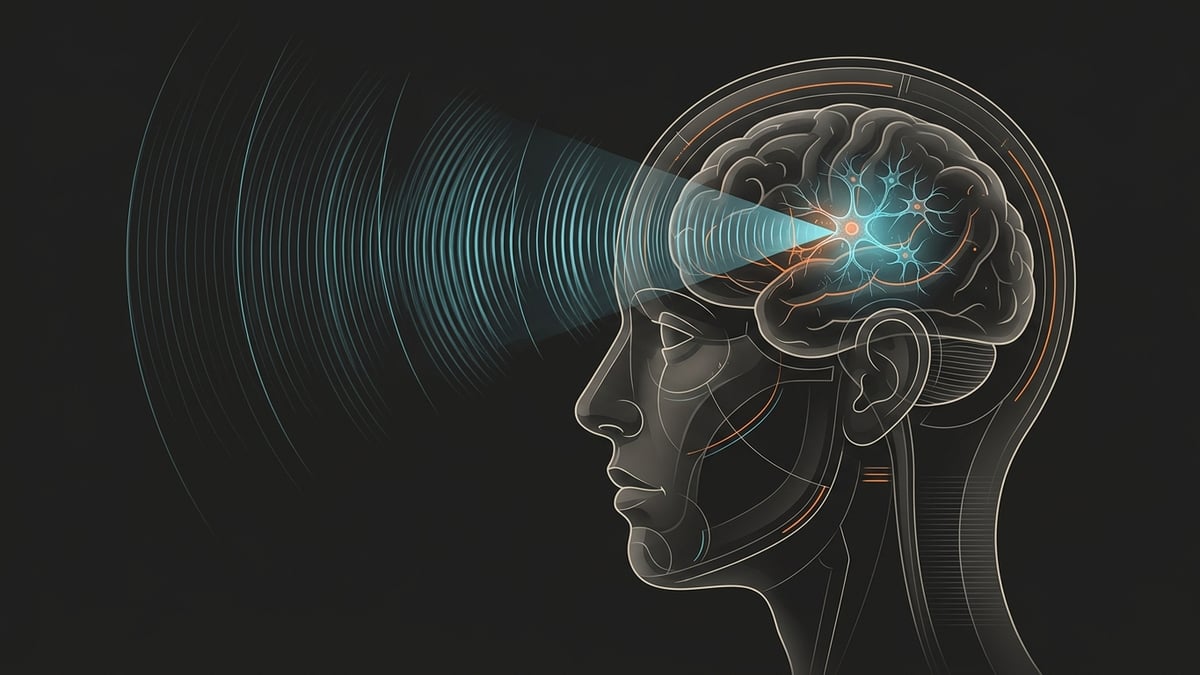
Ultrasound is sound. It is the same physical phenomenon as the pressure waves that carry a voice across a room — a mechanical oscillation traveling through a medium — at frequencies above the range of human hearing, which ends around 20 kilohertz. Most people meet it in an imaging suite, where a transducer pressed against the skin sends pulses into the body and reads the echoes. The same physics drives sonar, and, at different intensities, the handheld units physical therapists have used for decades.
Ultrasound neuromodulation is the idea that these pressure waves might do more than form images. At low intensities, directed at nervous tissue, they may interact with the nervous system directly — mechanically, rather than chemically the way a drug does, or electrically the way an electrode does. That one sentence carries the entire premise of the field UltraDAO works in.
This post is a plain-language introduction to that field: what the physics is, why researchers find the mechanical route interesting, what is and is not established, and how we approach it.
Pressure, not chemistry or current
A neuron is usually described in electrical and chemical terms — membrane potentials, neurotransmitters, ion channels. But it is also a physical object. Its membrane has tension. Its channels are proteins that change shape. Its interior is scaffolded by a cytoskeleton. A pressure wave passing through tissue pushes on all of this, cyclically, up to a million times per second.
The established ways of influencing the nervous system each carry a cost. Chemistry — a pharmaceutical — reaches the whole body through the bloodstream and is difficult to confine to one region. Electricity is precise but generally wants a conductor: electrodes on the skin at the mild end, implanted hardware at the invasive end. Ultrasound offers a third property set. It passes through skin and soft tissue without an incision. It can be aimed, because sound at these frequencies travels in beams that can be directed. And it introduces no compound and no implant. Non-invasive, aimable, drug-free: that combination is why the mechanical route keeps drawing research attention.
In practice, a research instrument shapes the sound in two layers. A carrier — 1 MHz, in the device we work with — does the physical traveling through tissue. A pulse envelope switches that carrier on and off at a much lower rate, and most of what we call a frequency program is a choice of envelope: its rate, its duty cycle, its structure.
The honest state of the field
Ultrasound neuromodulation is an active research area, not an established therapy. Laboratories around the world are studying how neural tissue responds to low-intensity ultrasound, and the open questions are still fundamental ones: which mechanical effects matter, which parameters produce which responses, how to target reliably, how effects should be measured at all. Work so far spans bench studies, animal models, and early human research, and the field has not converged on settled answers.
We think it is important to say this plainly, because the alternative — implying more certainty than exists — is how a field loses trust before it has earned any.
Ultrasound neuromodulation is a question under active investigation, not an answer. Anything presented as settled should be read with suspicion — including anything from us.
How UltraDAO approaches it
UltraDAO is a community-funded research effort. Rather than beginning with a laboratory and working outward, we began with an instrument people can actually hold: PULSE, a hardware module (revision A1) that modifies the US PRO 2000, a widely available 1 MHz handheld ultrasound unit. The modified device runs programmable frequency programs — pulse rates from 16 to 2000 Hz over the 1 MHz carrier, output up to 1.6 W/cm², an effective depth of about 40 mm in soft tissue. A program is loaded by tapping a phone to the device; the transfer is signature-verified and checksummed before anything lands. It is a research and development instrument, not a medical device.
The research directions we have stated publicly are three.
- Neurodegenerative disease. An interest in whether targeted ultrasound applied to neuronal structures deserves study in the context of conditions like Alzheimer's and dementia. This is a stated direction, not a body of findings.
- Consciousness studies. Our thinking here is influenced by the Orch-OR theory of Stuart Hameroff and Roger Penrose, which proposes a role for neuronal microtubules in consciousness. We want to be explicit: Orch-OR is a contested theoretical position within the academic literature, not accepted science. We treat it as an influence on what seems worth investigating, nothing more.
- Nervous-system modulation. Broader questions about ultrasound and the autonomic nervous system, particularly the vagus nerve and parasympathetic function.
These are directions. We do not claim results, and we will not until there are results to claim.
An at-home memory study
The concrete work underway is the Ultrasound Memory Study, run in partnership with IONS under a protocol described as IRB-approved. It asks whether targeted low-intensity ultrasound delivered by the US PRO 2000 can be used safely in the context of short-term memory recall and cognitive performance — a question to examine, not an outcome to report.
The protocol is structured: at-home use three times a day for three weeks, followed by a week off; surveys before starting and monthly, covering memory, mood, and quality of life; and a short daily usage assessment. Enrollment is limited to adults 18 and over, requires a doctor's authorization letter and a US Pro 2000, and is free and voluntary. It is an at-home, survey-based design — modest by intent, because modest and real is worth more than ambitious and imagined.
If the field interests you, the place to start is our research page, which lays out the three tracks in more detail. If the study interests you — or someone you know is experiencing memory issues and might qualify — enrollment is described at the study page, with participant resources on the study resources page. The instrument itself, spec sheet included, lives at the device page.
UltraDAO devices and frequency programs are wellness and research instruments. The PULSE system is not a medical device, is not FDA cleared, and nothing in this post is medical advice — no therapeutic claims are made. Ultrasound neuromodulation is an active area of research; consult a qualified clinician for health decisions.