
Most medical research follows a familiar arc. Public money funds the early, uncertain work. A private company acquires the resulting intellectual property. And the people who mattered most at the start — the trial participants, the early adopters, the taxpayers — end their involvement holding nothing. The risk was shared widely; the ownership was not.
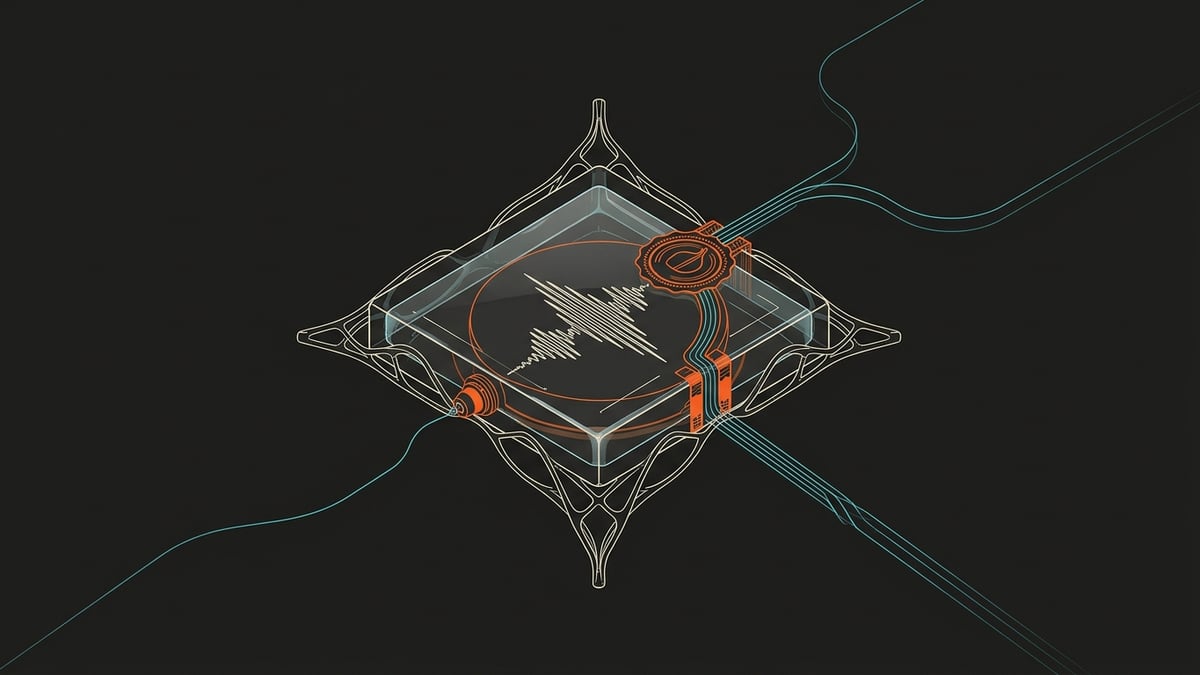
UltraDAO's IP-NFT model is an attempt to change where that ownership record sits. An IP-NFT is an on-chain record of ownership over a piece of research intellectual property. In our system the IP is not abstract: it is a specific frequency program, the kind you can flash to a physical device and run. This post walks through what you actually hold, where the record lives, how it connects to hardware, and what the economic loop around it is designed to do.
Who ends up owning publicly funded research
The problem framing on our IP-NFT page comes down to three patterns, and none of them is controversial to name.
- The public funding paradox. Taxpayers fund research through public institutions, and the resulting innovations are frequently locked behind expensive paywalls.
- Tech transfer friction. Academic work, funded by public money, often gets trapped in restrictive technology-transfer contracts that disconnect researchers from their own innovations.
- Extreme markups. The companies that commercialize the results often price them out of reach of the very people who helped fund their development.
Cutting across all three is a fourth pattern: the people who take the greatest risks in medical advancement — early adopters and test participants — historically receive the least reward. They contribute time, data, and participation to the validation of a technology, and hold no stake in what it becomes.
What an UltraDAO IP-NFT actually is
The word NFT carries baggage, so it is worth being precise.
On UltraDAO an IP-NFT is not an abstract collectible. It is a specific frequency program that you own and can use on a real device.
A frequency program is a small, signed piece of firmware that tells the device what to play: a plain frequency, such as a 39 Hz program, or a nested one, such as a 39 Hz envelope shaping a 1755 Hz carrier under a 45:1 phase lock. The program is the intellectual property. The IP-NFT is the ownership record bound to it.
On the chain side, the record uses KRC-721, the NFT standard on Kaspa — the same network where our token $ULTRA is deployed under the KRC-20 standard. Kaspa's role here is simple: it is the public ledger where the ownership record lives.
Provenance and portability
The word record is doing the important work in that description. When you acquire an IP-NFT, the entry that says you own it sits in your wallet on a public chain — not in a row in our database. That distinction has practical consequences.
- Provenance. The chain keeps a timestamped history of the record: when it was minted and how it has moved since. Nobody has to take our word for who owns what.
- Portability. The record travels with your wallet. It does not depend on your account with us.
- Independence. Traditional ownership records depend on a registrar to keep the book. An on-chain record does not.
We still run infrastructure — the website, the app, the keys that provision devices. But the ownership record itself is not something we hold on your behalf, and that is the point.
The binding to hardware
An ownership record alone is thin. What makes the UltraDAO IP-NFT concrete is that it is paired with something that actually runs.
PULSE is our hardware module. It modifies the US PRO 2000, a handheld ultrasound device, into a programmable instrument that can play the frequency library. Programs load over NFC: you tap your phone to the device, the signed payload transfers, the device verifies the signature against UltraDAO-provisioned keys, CRC-checks the transfer, and flashes the program. A payload with a bad signature never lands, and PULSE is the hardware built to decode UltraDAO-signed programs.
So the pairing runs in both directions. The IP-NFT is an ownership record for a program; PULSE is the instrument that executes that program. The record points at something usable, and the usable thing is bound to the same system the record lives in. That is the difference between owning a stake in research IP and owning a token that links to an image.
The intended loop, described plainly
The economic design goal is a loop. Research produces frequency programs. Programs are issued as IP-NFTs. Acquisitions and royalties from those programs are designed to flow back to the DAO treasury, which is held in KAS. The treasury funds further research, which produces the next generation of programs. Ownership feeds the work that creates more things to own.
We want to be plain about the state of this. It is a design goal of an early system, not an operating history. We are not publishing royalty percentages, distribution schedules, or rights terms in this post, because those mechanisms are not finalized — and describing the shape of the loop honestly seems better than dressing up terms that do not yet exist. What we can state is the direction the model is built to point: value generated by the research flowing back into the research, with the people who supported the work early holding a recorded stake rather than a receipt.
If the framing interests you, the IP-NFT page lays out the ownership argument in full, and the device page covers the PULSE hardware the programs run on. For how the organization behind both is structured, see the DAO page.
UltraDAO devices and frequency programs are wellness and research instruments. The PULSE system is not a medical device, is not FDA cleared, and nothing in this post is medical advice — no therapeutic claims are made; ultrasound neuromodulation is an active area of research, and health decisions belong with a qualified clinician. This post is also informational only: it is not an offer to sell, or a solicitation of an offer to buy, any token, NFT, or security, and it is not investment, legal, or tax advice. Nothing here is an invitation to vote or to transact.